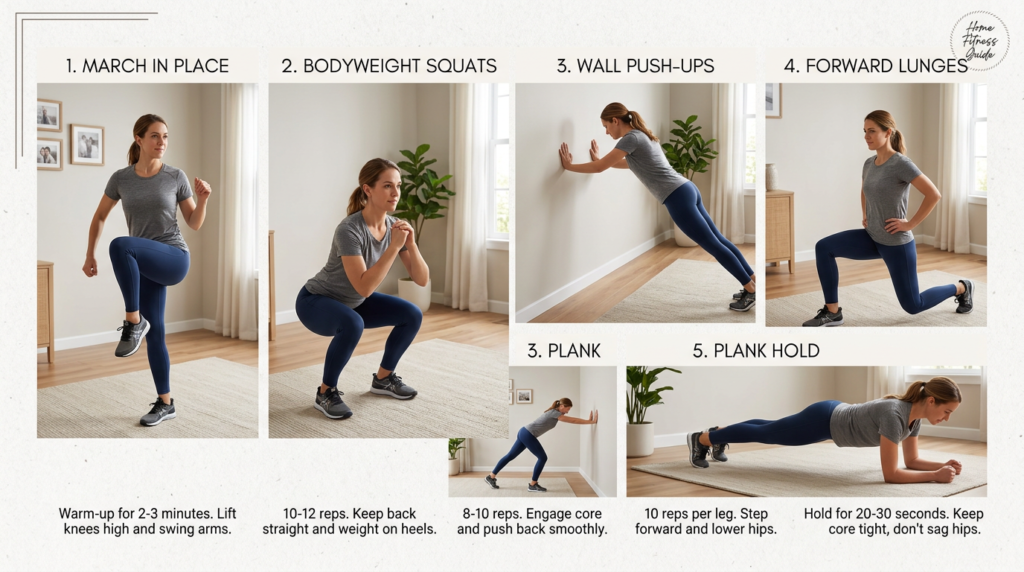


This article explains muscle building exercises for lean muscle growth. It focuses on exercise selection, training structure, progression, recovery, and nutrition. The goal is to provide a clear guide that can be used in a gym setting.
Lean muscle growth refers to increasing muscle mass with controlled fat gain. This happens through resistance training combined with proper food intake and recovery.
Muscle growth depends on repeated training stress and consistent progression. Exercises included in this guide target major muscle groups and movement patterns used in gym training.
How Muscle Growth Happens
Muscle growth happens when muscle fibers are exposed to resistance and recover over time. Training creates stress in muscle tissue. Recovery allows repair and adaptation.
Three main factors influence growth:
Training load
Recovery time
Nutrition intake
If any factor is missing, progress slows.
Training Principles for Muscle Growth
Progressive overload
Progressive overload means increasing training demand over time.
Methods:
Increase weight
Increase repetitions
Increase sets
Improve movement control
Movement patterns
All exercises follow movement patterns:
Push
Pull
Squat
Hinge
Core stability
Training all patterns supports balanced muscle development.
Recovery
Recovery allows muscle repair.
Includes:
Sleep
Rest days
Food intake
Best Muscle Building Exercises
The following exercises target all major muscle groups.
Squat
Squat trains lower body muscles and core stability.
Muscles involved:
Quadriceps
Hamstrings
Glutes
Lower back
Execution:
Bar placed on upper back or use machine
Feet placed shoulder width
Lower body under control
Return to standing position
Sets and reps:
3 to 4 sets × 6–10 reps
Deadlift
Deadlift trains posterior chain muscles.
Muscles involved:
Back
Hamstrings
Glutes
Forearms
Execution:
Bar placed on floor
Grip bar
Lift by extending hips and knees
Return with control
Sets and reps:
3 sets × 5–8 reps
Bench Press
Bench press trains upper body pushing muscles.
Muscles involved:
Chest
Shoulders
Triceps
Execution:
Lie on bench
Hold bar above chest
Lower bar to chest
Press upward
Sets and reps:
3 to 4 sets × 6–10 reps
Overhead Press
Overhead press trains shoulder strength.
Muscles involved:
Shoulders
Triceps
Upper chest
Execution:
Bar or dumbbells at shoulder level
Press weight overhead
Lower under control
Sets and reps:
3 sets × 6–10 reps
Bent-Over Row
Row trains back muscles and posture control.
Muscles involved:
Upper back
Middle back
Biceps
Execution:
Bend forward
Pull weight toward torso
Lower with control
Sets and reps:
3 to 4 sets × 8–12 reps
Lat Pulldown
Lat pulldown trains pulling strength.
Muscles involved:
Lat muscles
Upper back
Biceps
Execution:
Sit at machine
Pull bar toward chest
Return slowly
Sets and reps:
3 sets × 10–12 reps
Lunges
Lunges train balance and leg strength.
Muscles involved:
Legs
Glutes
Core
Execution:
Step forward
Lower body
Return to standing
Repeat other leg
Sets and reps:
2 to 3 sets × 10 reps each leg
Leg Press
Leg press trains lower body without free balance requirement.
Muscles involved:
Quadriceps
Glutes
Hamstrings
Execution:
Sit in machine
Push platform forward
Return under control
Sets and reps:
3 sets × 10–12 reps
Biceps Curl
Biceps curl isolates arm muscles.
Muscles involved:
Biceps
Execution:
Hold dumbbells
Curl weight upward
Lower under control
Sets and reps:
2 to 3 sets × 10–12 reps
Triceps Pushdown
Triceps pushdown trains arm extension strength.
Muscles involved:
Triceps
Execution:
Use cable machine
Push handle downward
Return slowly
Sets and reps:
2 to 3 sets × 10–12 reps
Core Exercises
Plank
Plank trains core stability.
Hold body position
Keep spine stable
Leg raise
Leg raise trains lower abdominal muscles.
Lift legs upward
Lower slowly
Sets:
3 sets per exercise
Weekly Training Structure
Option A: 3-day plan
Monday: Full body
Wednesday: Full body
Friday: Full body
Option B: 4-day plan
Monday: Upper body
Tuesday: Lower body
Thursday: Upper body
Friday: Lower body
Progressive Overload Method
Progress is achieved by increasing training demand.
Example:
Week 1: squat 50 kg × 8
Week 2: 50 kg × 9
Week 3: 50 kg × 10
Week 4: 55 kg × 8
Rest Between Sets
Heavy exercises: 90–180 seconds
Medium exercises: 60–90 seconds
Isolation exercises: 30–60 seconds
Warm-Up Routine
Warm-up prepares the body.
Steps:
5–10 minutes light movement
Joint mobility work
Light set of main exercise
Nutrition for Lean Muscle Growth
Protein
Supports muscle repair.
Sources:
Chicken
Eggs
Fish
Beans
Daily intake:
1.6 to 2.2 g per kg body weight
Carbohydrates
Provide training energy.
Sources:
Rice
Oats
Potatoes
Fruits
Fats
Support body function.
Sources:
Nuts
Olive oil
Seeds
Water
2 to 3 liters per day
Recovery Plan
Sleep
7 to 9 hours per night
Rest days
2 to 3 days per week
Light activity
Walking
Stretching
Common Mistakes
No progression
Training must increase over time.
Poor form
Form must be controlled.
Skipping rest
Recovery is required.
Inconsistent schedule
Routine must be repeated weekly.
Tracking Progress
Methods:
Weight lifted
Repetitions
Body weight
Training log
Example:
Bench press: 40 kg × 10, 9, 8
Squat: 60 kg × 10, 9, 8
Row: 45 kg × 12, 10, 10