

This article explains gym exercises for beginners who want to improve stamina and power. It focuses on exercise selection, training structure, progression, rest, and basic nutrition. The goal is to provide a clear plan that can be followed in a gym setting without confusion.
Stamina refers to the ability to sustain physical activity over time. Power refers to the ability to produce force quickly. Both can be developed through consistent resistance training and structured conditioning work.
How Stamina and Power Develop
Stamina and power develop through repeated training stress followed by recovery. The body adapts to load by improving muscle efficiency, energy use, and movement coordination.
Stamina development
Stamina improves through:
Repeated sets with moderate rest
Circuits involving multiple exercises
Steady cardiovascular work
Power development
Power improves through:
Lifting moderate to heavy weight with control
Performing explosive movements with correct form
Training compound lifts consistently
Training Principles
- Progressive overload
Progressive overload means increasing training demand over time. This can be done by:
Increasing weight
Increasing repetitions
Increasing sets
Reducing rest time
- Movement patterns
All gym exercises are based on patterns:
Push
Pull
Squat
Hinge
Carry
Core stabilization
Training all patterns improves balance and strength.
- Recovery
Recovery allows muscle and energy system repair.
Recovery includes:
Sleep
Rest days
Nutrition
Reduced stress
Weekly Training Plan
This program uses 3 to 4 training days per week.
Schedule option A
Monday: Strength training
Wednesday: Conditioning
Friday: Strength training
Schedule option B
Monday: Full body
Tuesday: Light cardio
Thursday: Full body
Saturday: Conditioning
Strength Exercises for Beginners
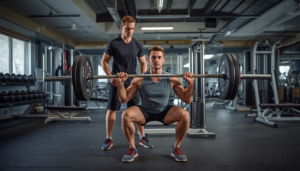
Squat
Squat trains legs and supports power in lower body movement.
3 sets × 6–10 reps
Deadlift
Deadlift trains back, hips, and legs.
3 sets × 5–8 reps
Bench press
Bench press trains pushing strength.
3 sets × 6–10 reps
Row
Row trains pulling strength and posture.
3 sets × 8–12 reps
Overhead press
Overhead press trains shoulder strength.
3 sets × 6–10 reps
Stamina Exercises for Beginners
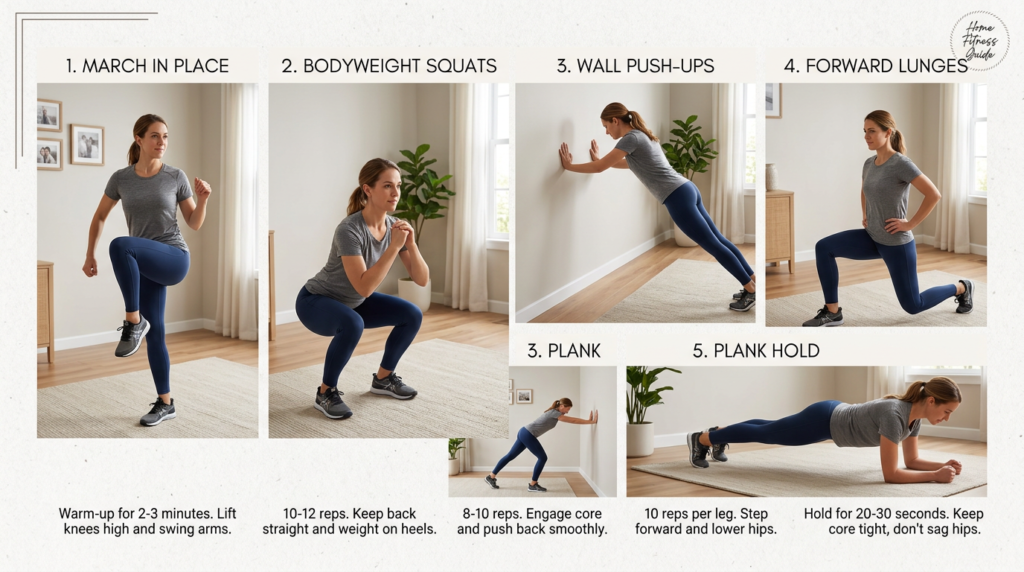
Circuit training
Circuit training includes multiple exercises with short rest.
Example circuit:
Bodyweight squat × 12
Push-ups × 10
Row machine × 12
Plank × 30 seconds
Repeat 3 to 4 rounds.
Walking on incline
20 to 40 minutes
Steady pace
Cycling
20 to 30 minutes
Moderate resistance
Rowing machine
10 to 20 minutes
Steady pace
Power Development Exercises
Explosive squat
Squat performed with controlled speed upward.
3 sets × 5 reps
Medicine ball throw
3 sets × 8 reps
Kettlebell swing
3 sets × 10–15 reps
Jump squat (bodyweight)
3 sets × 6–10 reps
Full Training Session Example
Day 1: Strength focus
Squat
Bench press
Row
Overhead press
Plank
Day 2: Stamina focus
Incline walking
Cycling
Circuit training
Rowing machine
Day 3: Power focus
Deadlift
Kettlebell swing
Medicine ball throw
Jump squat
Core exercise
Rest Between Sets
Strength exercises: 90–180 seconds
Stamina circuits: 30–60 seconds
Power training: 60–120 seconds
Rest time supports output and form control.
Warm-Up Routine
Warm-up prepares the body for training.
Steps
Light cardio for 5–10 minutes
Joint movement exercises
Light set of first exercise
Example:
Squat with light weight before working sets
Progressive Overload Method
Progress is tracked through:
Increased weight
Increased repetitions
Increased rounds in circuits
Improved movement control
Example progression
Week 1: squat 40 kg × 8
Week 2: 40 kg × 9
Week 3: 40 kg × 10
Week 4: 45 kg × 8
Nutrition for Stamina and Power
Protein
Supports muscle repair.
Sources:
Chicken
Eggs
Fish
Beans
Daily intake:
1.6 to 2.2 g per kg body weight
Carbohydrates
Support energy production.
Sources:
Rice
Oats
Potatoes
Fruits
Fats
Support hormone function.
Sources:
Nuts
Olive oil
Seeds
Water intake
2 to 3 liters per day
Recovery Guidelines
Sleep
7 to 9 hours per night
Rest days
1 to 3 days per week depending on schedule
Light activity
Walking
Stretching
Mobility work
Common Beginner Mistakes
Skipping strength training
Stamina improves better when strength base exists.
Using incorrect weight
Too heavy weight reduces form control.
No rest days
Recovery is required for progress.
Training without tracking
Progress cannot be measured without logs.
Tracking Progress
Methods
Weight lifted
Circuit rounds completed
Running or cycling duration
Body weight changes
Example log
Squat: 50 kg × 10, 9, 8
Row: 40 kg × 12, 10, 10
Cycling: 20 minutes steady
Weekly Example Summary
Monday
Strength training
Wednesday
Stamina training
Friday
Power training
Long-Term Development
After 8 to 12 weeks:
Increase training load
Add new exercises
Extend cardio duration
Adjust repetition ranges
Improve movement speed control
Safety Guidelines
Maintain controlled movement
Avoid rushing repetitions
Use correct form before increasing load
Stop if pain occurs
Ask for assistance when needed