

This article explains a simple gym workout routine for beginners who are starting a fitness journey. It focuses on structure, exercise selection, training frequency, progression, recovery, and basic nutrition. The goal is to provide a routine that can be followed without confusion.
Many beginners stop training early because they follow complex programs. A simple routine improves consistency and helps build strength and movement control. This article uses basic gym exercises and a clear weekly structure.
What a Beginner Needs From Gym Training
A beginner does not need advanced methods. The focus is:
Learning movement patterns
Building basic strength
Creating routine consistency
Avoiding injury
Tracking progress
Gym training works when repeated over time with gradual load increase.
Basic Training Principles
- Movement patterns
All gym exercises fall into main patterns:
Push (chest, shoulders, triceps)
Pull (back, biceps)
Squat (legs)
Hinge (back of legs, lower back)
Core (stability)
A beginner should train all patterns weekly.
- Progressive overload
Progressive overload means increasing training demand over time. This can be done by:
Adding weight
Adding repetitions
Adding sets
Improving form under load
Without progression, results slow down.
- Recovery
Muscle grows during rest. Recovery includes:
Sleep
Rest days
Food intake
Reduced stress
Training every day without recovery reduces performance.
Weekly Gym Schedule for Beginners
This routine uses 3 training days per week.
Schedule
Monday: Full body workout
Wednesday: Full body workout
Friday: Full body workout
Other days are rest or light movement days.
Full Body Workout Routine
Each session trains all major muscle groups.
Workout Plan A
Squat (machine or barbell)
3 sets × 8–10 reps
Bench press (machine or dumbbell)
3 sets × 8–10 reps
Lat pulldown
3 sets × 8–12 reps
Shoulder press
2–3 sets × 8–12 reps
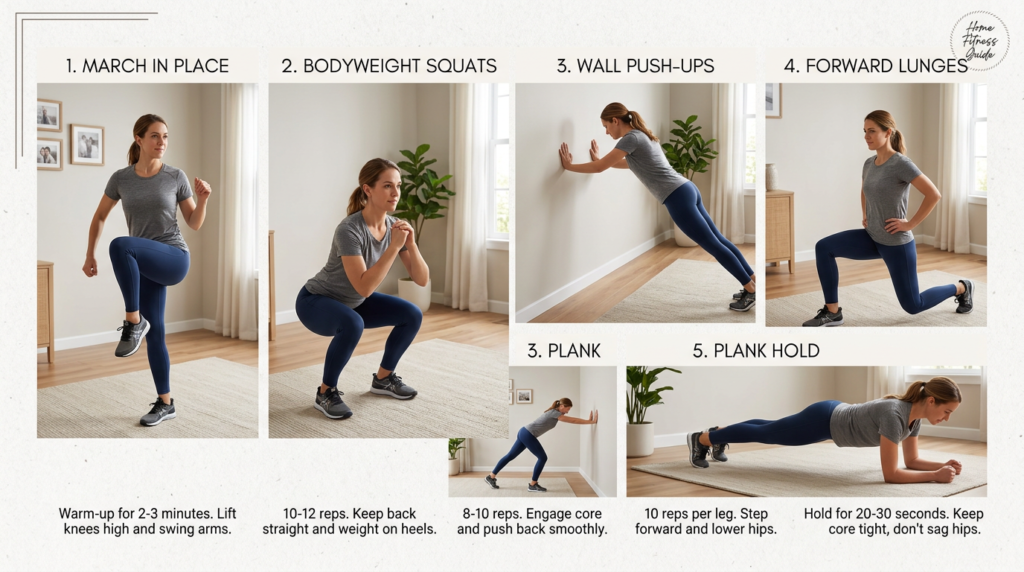
Plank
3 sets × 30–60 seconds
Workout Plan B
Leg press
3 sets × 10–12 reps
Dumbbell chest press
3 sets × 8–10 reps
Seated row
3 sets × 8–12 reps
Romanian deadlift
3 sets × 8–10 reps
Crunch or leg raise
3 sets × 10–15 reps
Weekly rotation
Week 1: A / B / A
Week 2: B / A / B
This rotation balances muscle stress.
Exercise Explanation
Squat
Squat trains legs and hips. It supports strength for daily movement.
Bench press
Bench press trains chest and pushing strength.
Lat pulldown
Lat pulldown trains upper back and pulling strength.
Shoulder press
Shoulder press trains upper body pushing movement.
Row
Row trains back muscles and posture support.
Romanian deadlift
Romanian deadlift trains back of legs and hip hinge movement.
Warm-Up Routine
Warm-up prepares the body for training.
Steps
5 minutes walking or cycling
Light mobility movement for joints
1–2 light sets of first exercise
Warm-up reduces risk of injury and improves movement control.
Rest Between Sets
Large exercises: 90–180 seconds
Smaller exercises: 60–90 seconds
Rest allows performance to remain stable across sets.
How to Progress in Training
Progression method:
Start with weight that allows full reps
When top reps are completed in all sets, increase weight
Increase slowly
Repeat process
Example:
Week 1: squat 40 kg × 8 reps
Week 2: 40 kg × 9 reps
Week 3: 40 kg × 10 reps
Week 4: 42.5 kg × 8 reps
Training Duration
Each session lasts:
45 to 75 minutes
Time depends on rest and exercise selection.
Nutrition Basics for Beginners
Food supports training output and recovery.
Protein
Protein supports muscle repair.
Sources:
Chicken
Eggs
Fish
Beans
Milk
Daily intake:
1.6 to 2.2 grams per kg body weight
Carbohydrates
Carbohydrates provide training energy.
Sources:
Rice
Oats
Potatoes
Bread
Fruits
Fats
Fats support body function.
Sources:
Nuts
Olive oil
Eggs
Fish
Water
Water supports performance.
2 to 3 liters per day
Recovery Guidelines
Recovery supports progress.
Sleep
7 to 9 hours per night
Rest days
At least 2 rest days per week
Light activity
Walking
Stretching
Mobility work
Common Beginner Mistakes
Using too much weight
This reduces form quality. Start with manageable load.
Skipping rest days
Recovery is part of training.
No tracking
Without tracking, progress is unclear.
Changing program too often
A routine needs time to show results.
Tracking Progress
Tracking helps measure improvement.
Methods
Weight used in exercises
Number of repetitions
Body weight changes
Monthly photos
Notes in training log
Example log
Squat: 50 kg × 10, 10, 9
Bench press: 35 kg × 10, 9, 8
Row: 40 kg × 12, 10, 10
Gym Safety Guidelines
Keep controlled movement
Do not rush repetitions
Use proper equipment setup
Stop if pain occurs
Ask for help when needed
Beginner Progress Timeline
First 4 weeks
Learning movement
Adjusting to routine
Weeks 5–8
Increased strength
Better control
Weeks 9–12
Noticeable progression in weights
Improved endurance
Long-Term Training Approach
After completing beginner phase:
Increase training volume
Add new exercises
Move to split routine
Adjust repetition ranges
Focus on weak areas
Sample Weekly Overview
Monday
Full body A
Wednesday
Full body B
Friday
Full body A
Next week reverses pattern.